
Getting Started with the Players Module
If you are looking to quickly get started creating and publishing a player, check out the Step-by-Step: Using the Players Module to Create and Publish a Player topic.
Using the Players module
To access the Players module, login to Studio and click Players in the left sidebar navigation.
The player list displays the following columns:
- Name - Player name
- Player ID - Player ID
- Status - Indicates whether the player is active or inactive
- Player Type - Single Video, Playlist, or Outstream
- Published State - Published or Draft
- Date Created - Date and time the player was created
- Updated - Date and time of the last update
- Version - Player version number
You can customize which columns are displayed by clicking the column visibility button in the table header. Columns can also be reordered by dragging.
Using the Players module, you can:
Creating a new player
To create a new player using the Players module:
- Click Add player.
- Enter a Name and optional Short Description for the player and then click Create.
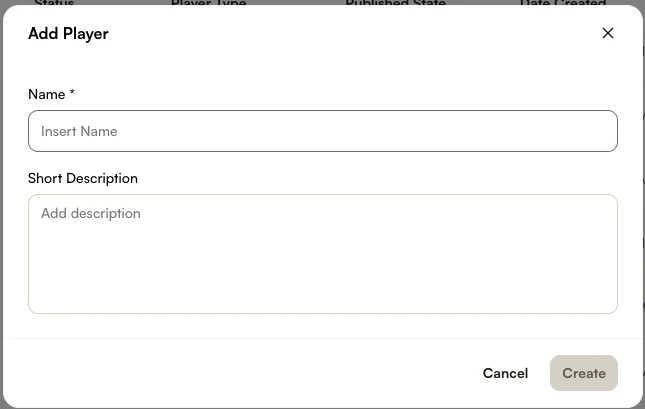
- The new player will appear in the list of players.
When a new player is created using the Players module, the player is built using the latest player version as published by Brightcove. The player version appears on the Players module homepage. Note that all players may not be the same version. As Brightcove continues to develop and improve the Brightcove player, new player versions will be released. By default, updates are applied to all players automatically. To prevent auto-updating of a player, you must set the Update Mode setting to Manual (also known as locking a player). For more information, see Setting the Player Update Mode and Version.
Editing player properties
To edit player properties, click on a player name in the list. The player detail page will open with a video preview on the left and collapsible property sections on the right.
The right side navigation provides three tabs to organize player settings:
- Overview - Information, Styling, Playback, Controls, Social, End Screens, Plugins, Advertising, Content Restrictions, JSON Editor
- Additional Features - Interactivity, Campaigns, Recommendations Engine
- Analytics - Viewer ID Tracking, Google Analytics, Adobe Analytics
Expand any section to view and edit its settings. For information on configuring player properties, see Setting Player Properties.
Duplicating a player
Duplicating a player allows you to create a new player based upon an existing player. To duplicate a player in the Players module:
- Click the three-dot menu (⋯) at the end of the player row you want to duplicate.
- Click Duplicate.
- Enter a Name and Short Description for the player.
- Click Create.
Deleting players
Deleting a player removes it from your account and cannot be undone. To delete a player in the Players module:
- Click the three-dot menu (⋯) at the end of the player row.
- Click Delete.
- Confirm the deletion by clicking Delete.
You can also delete a player from the player detail page by clicking the three-dot menu (⋯) next to the Publish changes button and selecting Delete.
Searching for players
The Search by name or ID field can be used to search the players in your account.
Filtering and sorting players
The player list can be filtered and sorted to find specific players:
- Filtering - Click the filter button to filter by Player Type, Published State, or Status.
- Sorting - Click the sort button to sort by Name, Date Created, Updated, Status, or Published State. You can also click any column header to sort by that column.
Generating the embed code and previewing a player
The Embed & Preview button on the player detail page opens the Embed Player dialog. This dialog provides:
- Embed code in iframe or JavaScript format with a Copy code button
- A URL button to copy the player URL
- A Preview button to preview the player
You can also access the Embed & Preview option from the three-dot menu (⋯) on the player list page.
For more information, see Generating Player Embed Code.